
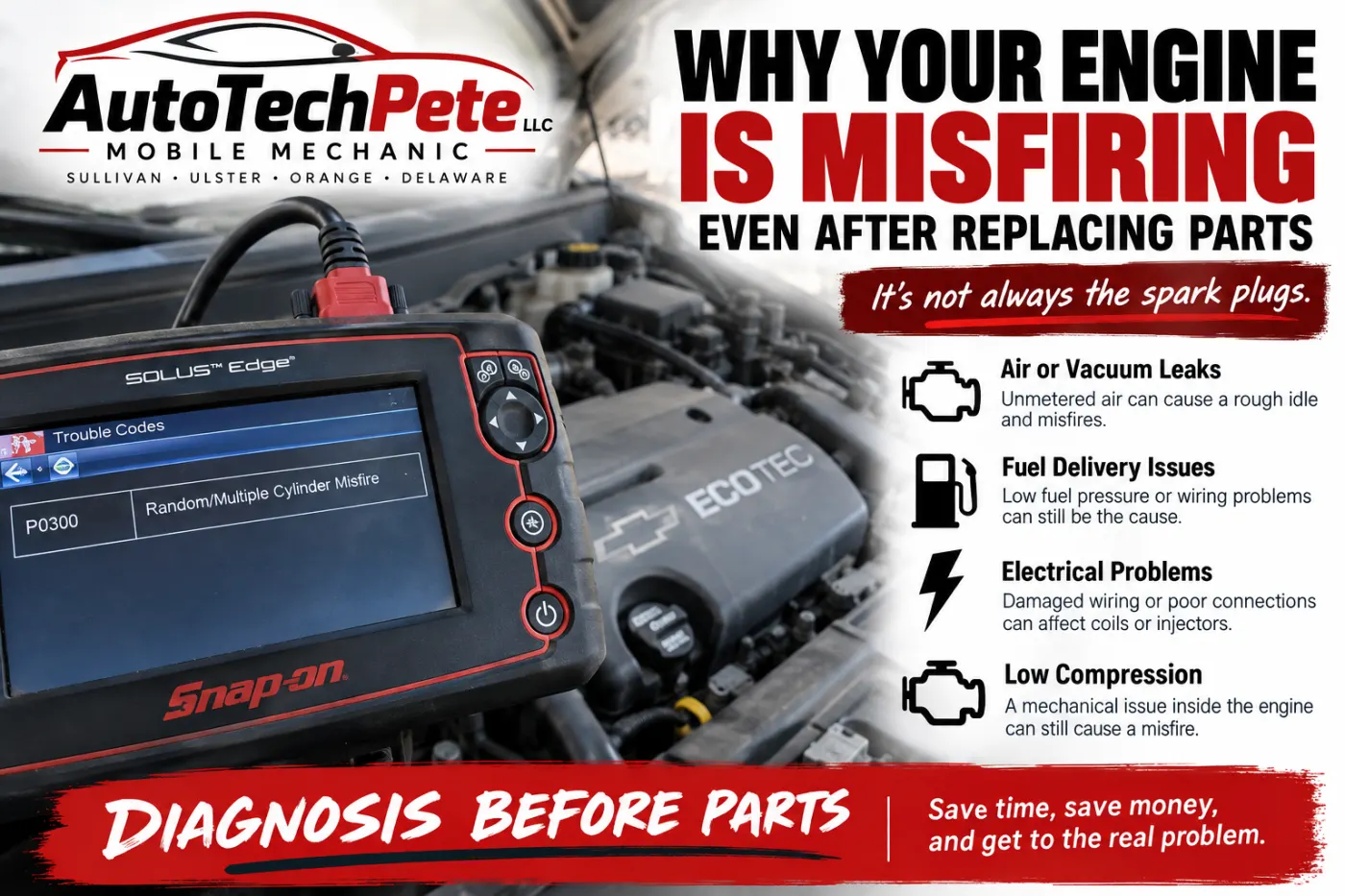
An engine misfire can be frustrating, especially when you’ve already replaced parts and the vehicle is still running rough.
A common reaction when a check engine light comes on with a misfire is to start with spark plugs, ignition coils, fuel injectors, or even the mass airflow sensor. Those components can absolutely cause a misfire, but they aren’t the only possibilities.
We recently came across a vehicle that was a good example of why diagnosing a misfire can sometimes go much deeper.
The vehicle was running rough and the check engine light was on. Scan data showed multiple misfires, with a lot of the activity initially showing around one cylinder.
The spark plugs had already been replaced. The ignition coil was checked and appeared to be working properly. The fuel injector for the problem cylinder was replaced, and the mass airflow sensor had also previously been replaced.
The engine was still misfiring.
At that point, continuing to replace parts wasn’t the right answer.
WHAT ELSE CAN CAUSE AN ENGINE MISFIRE?
An engine needs the right amount of air, fuel, spark, and compression to run correctly. If any one of those is missing or incorrect, a cylinder may misfire.
Once the common ignition and fuel components have been checked, there are several other possibilities.
AIR OR VACUUM LEAKS
Unmetered air entering the engine can throw off the air/fuel mixture and cause rough running or misfires.
Possible causes include a leaking intake manifold gasket, damaged vacuum hose, PCV system problem, or another intake leak.
FUEL DELIVERY PROBLEMS
Replacing a fuel injector doesn’t automatically rule out the entire fuel system.
Low fuel pressure, injector wiring problems, electrical connector issues, or other fuel delivery problems can still cause an engine to misfire.
ELECTRICAL PROBLEMS
Sometimes the component itself is fine, but the wiring supplying it isn’t.
Damaged wiring, loose connectors, corrosion, poor grounds, or other electrical problems can interfere with an injector or ignition coil.
LOW COMPRESSION
This is where a misfire can become more serious.
Every cylinder needs compression to properly burn the air and fuel mixture. A cylinder can have a good spark plug, working ignition coil, and functioning fuel injector and still misfire if it cannot produce enough compression.
Low or no compression can be caused by problems such as a valve that isn’t sealing correctly, valvetrain damage, piston or piston ring damage, or other internal engine problems.
In the vehicle mentioned earlier, further testing eventually found that the problem cylinder had no compression.
At that point, the problem was no longer something that replacing another ignition or fuel component was going to solve. The engine had an internal mechanical problem that required further engine repair or replacement.
WHY A COMPRESSION TEST CAN BE IMPORTANT
A compression test measures how much pressure each cylinder can produce.
If most cylinders produce normal compression but one cylinder is extremely low or has no compression, that tells us the problem may be mechanical rather than simply an ignition or fuel issue.
Additional testing, such as a leak-down test, can then help determine where that compression is being lost.
DON’T KEEP THROWING PARTS AT A MISFIRE
This is one of the biggest lessons with engine misfires.
Replacing parts based only on what might be wrong can become expensive very quickly.
Spark plugs might be replaced. Then ignition coils. Then injectors. Then sensors.
If the real problem is low compression or another internal engine issue, none of those parts will fix it.
Testing and narrowing down the problem before continuing to replace parts can save a lot of money and frustration.
WHAT SHOULD YOU DO IF YOUR VEHICLE IS MISFIRING?
If your vehicle is shaking, running rough, losing power, or has a check engine light on, having the vehicle scanned and properly diagnosed is a good place to start.
If the check engine light is flashing, the misfire may be severe enough that continuing to drive could damage the catalytic converter. It’s best to avoid unnecessary driving until the problem is checked.
A steady check engine light can still indicate an active problem and shouldn’t simply be ignored.
Sometimes a misfire turns out to be something relatively straightforward, such as a plug, coil, injector, wiring issue, or air leak.
Other times, further testing may reveal a mechanical problem inside the engine.
The important thing is finding out what is actually wrong before continuing to replace parts.
AutoTechPete provides mobile automotive diagnostics and repair throughout Sullivan County and surrounding areas. We can help diagnose many common check engine light, rough-running, starting, ignition, fuel, and electrical problems right where your vehicle is located.
When a problem requires internal engine work or specialized testing beyond what can reasonably be performed in a mobile setting, we’ll explain what we found and recommend the appropriate next step rather than continuing to replace parts unnecessarily.